Clinical mastering — AI · hybrid · fully human music

Your track has a diagnosis.
Not just a volume knob.

LookyMaster examines your song across seven clinically-anchored frequency zones, shows you exactly what's wrong, and masters it with the fix — in your browser.

◉ Your song never leaves your computer. Nothing uploads. Ever.

Start mastering From $12/mo · cancel anytime · your audio never uploads
Profiled on a 25-master commercial corpus −1.0 dBTP ceiling, guaranteed by measurement 7-zone spectral anatomy, every border cited Runs 100% client-side — zero upload
The problem

Every recording has a signature. Aberrations the ear pays for — and generic mastering doesn't see.

AI-generated, hybrid, or fully human — every production carries its own aberrations. Scanned closely, they resolve into artifacts that interfere with the regions where human hearing lives — and research associates energy in some bands with listening fatigue and hearing damage. Our filter system was developed from that science: find each artifact, treat it, bound the doses.

2.5–5.5 kHz

The aversion & damage band

Research places listener aversion at 2.5–5.5 kHz and noise-induced hearing damage near 4 kHz. Harsh energy here fatigues every ear. Our dose caps are strictest in this band — by design, for every genre.

grid

Detuned harmonic families

One slightly-off fundamental poisons every band — common in AI renders, live takes, and vintage samples alike. We detect the family and name the single root cause.

1–4 kHz

The presence dip

Vocals behind a blanket — the signature of home studios and generative renders both. We lift clarity below the ear-canal resonance: presence without the fatigue penalty.

>3.4 kHz

Static machine residue

Frozen, unchanging high-frequency lines that real cymbals and breath never produce — from generators, plugins, or damaged converters. Detected by physics, dipped surgically.

no address

Phase-coincidence spikes

Neural generators are trained by phase-blind losses — so they ship faint ticks made of many small components aligning at once. Measured: 14–100× the spike density of non-neural audio. We detect the alignments and scatter them — spectrum untouched.

~17.6 kHz

The bandwidth ceiling

AI renders and heavy processing chains cut the top octave dead. A blind "air boost" amplifies silence — the honest fix is slope-matched bandwidth extension.

The instrument

Seven plates. Every border is physiology, not a round number.

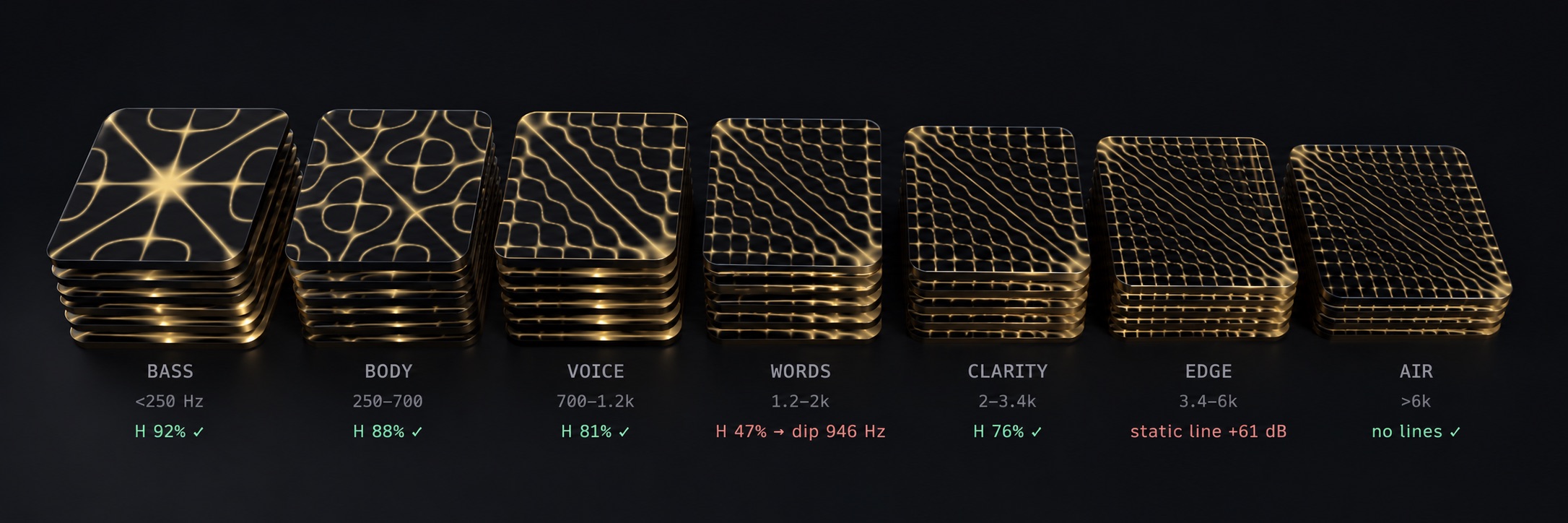
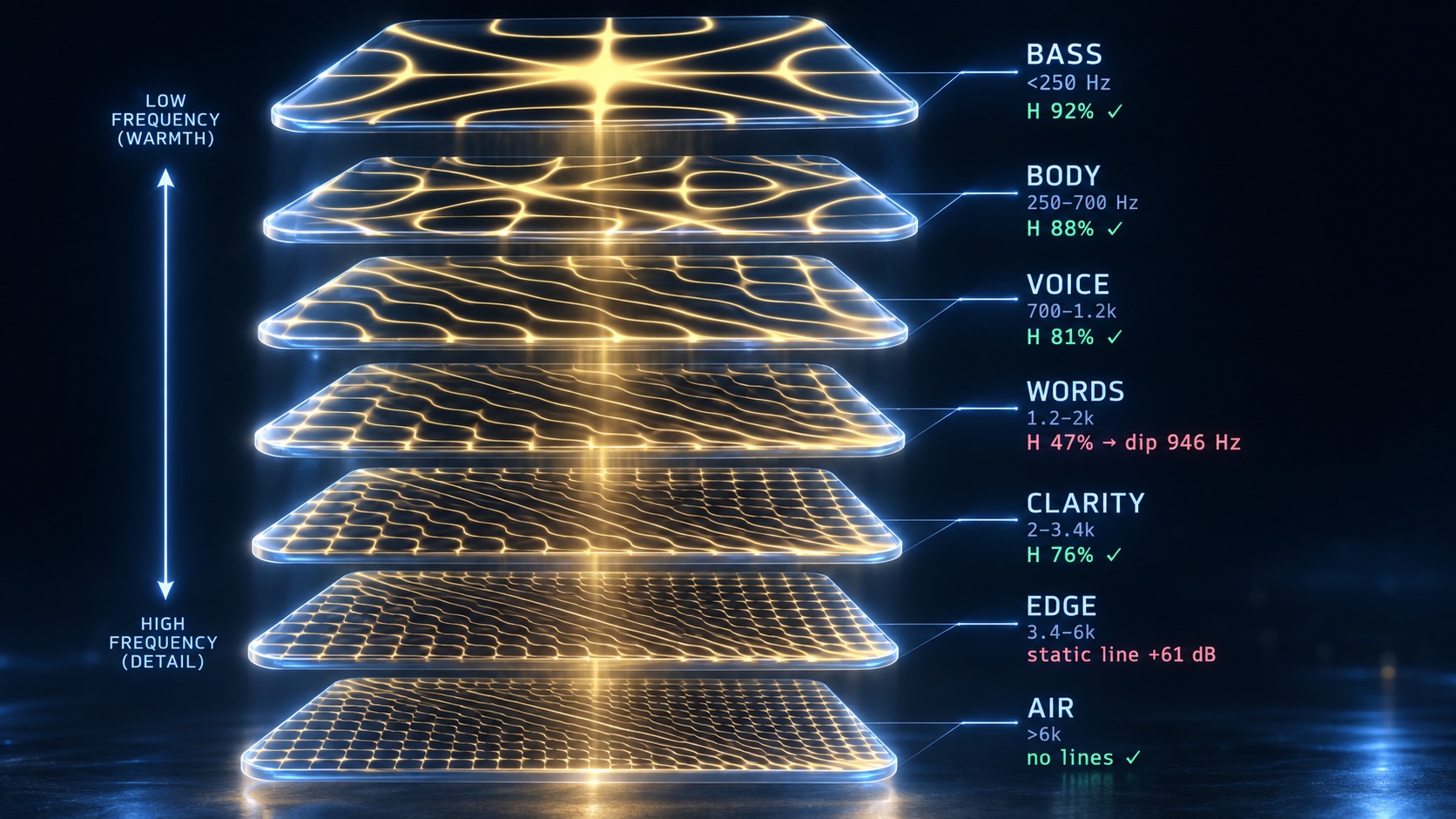
Your track's standing-wave patterns, drawn live per zone — voice floor at 250 Hz, the mud line at 700, the F1/F2 formant border at 1.2 k, the ear-canal resonance at 3.43 k. When a plate looks sick, the name of the plate is half the diagnosis.

BASS
<250 Hz
H 92% ✓
BODY
250–700
H 88% ✓
VOICE
700–1.2k
H 81% ✓
WORDS
1.2–2k
H 47% → dip 946 Hz
CLARITY
2–3.4k
H 76% ✓
EDGE
3.4–6k
static line +61 dB
AIR
>6k
no lines ✓
The physics

The algorithm, drawn. Why no two zones look alike.

Each zone is rendered as a Chladni plate — the physics of a vibrating surface, where a tone's frequency sets the pattern's complexity by the plate law f ∝ n²+m². Low frequencies can only draw a few sweeping curves; high frequencies force fine lattices. That's why BASS blooms like a star and AIR weaves a grid — the shapes aren't styled, they're computed.

Exploded stack of seven cymatic plates, BASS through AIR, each labeled with its frequency range and harmonicity diagnosis
A real exam. Five zones healthy (green) — untouched by the engine. WORDS fails harmonicity → one dip at the measured offender, 946 Hz. EDGE carries a static machine line +61 dB above its floor → attenuated inside the aversion band. Healthy tissue is never treated.
Seven stacked cymatic plates in a row, sparse curves at BASS progressing to fine grids at AIR
Left to right: modal order rising with frequency. A trained eye reads a mix from these seven figures the way a physician reads a chart — which is exactly the point. Patent pending 64/132,904.
How it works

Drop a file. Read the chart. Press one button.

Drop your track

WAV, MP3, FLAC. It opens in your browser's own audio engine — our servers never see a single sample.

Get the diagnosis

Seven plates, harmonicity per zone, tick census, loudness, true peak, listening-fatigue read — with healthy ranges shown next to your numbers.

One-press master

Streaming spec, commercial loud, or Smart Layers — which treats only the zones that are actually sick and leaves healthy ones untouched.

Verify, then export

Before/after table, volume-matched A/B so louder can't masquerade as better, 24-bit WAV out. Every claim measured.

◉ PRIVATE BY ARCHITECTURE

Other services upload your unreleased music to their servers. LookyMaster's entire engine runs client-side — your demos, your stems, your unreleased album stay on your machine. Not a policy promise. A physical fact.

The science

Designed by a physician. Every threshold has a citation.

LookyMaster was created by Dr. Willis Dennis Grajales, O.D. — a physician who spent a career measuring how the eye focuses light, applying the same discipline to how the ear receives sound.

The engine treats the 2.5–5.5 kHz listener-aversion band with documented caution, guards the 4 kHz region where noise exposure carves its notch, and refuses moves that trade short-term "impressiveness" for listening fatigue. Loud is easy. Comfortable-for-an-hour is engineering.

Where competitors ship a black box, every LookyMaster threshold traces to published research — and the diagnosis screen shows you the numbers, the healthy ranges, and the reason.

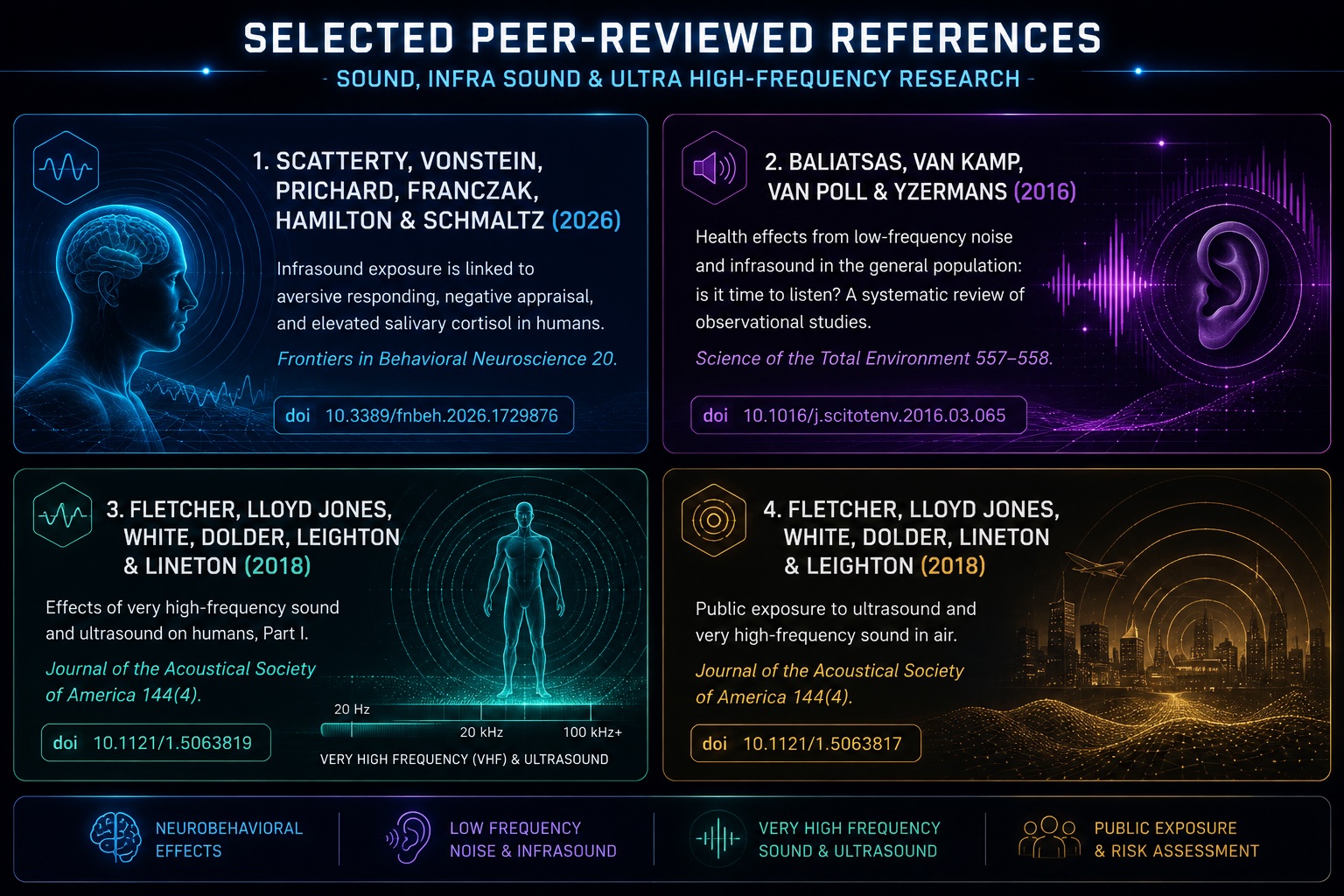
SELECTED REFERENCES IN THE ENGINE
  • Kumar et al. 2008/2012 — aversive spectral region 2.5–5.5 kHz
  • McBride & Williams 2001 — the 4 kHz noise-damage notch
  • Zekveld & Kramer 2010 — pupillometry & listening effort
  • Plomp & Levelt 1965 — roughness & critical bandwidth
  • McDermott et al. 2010 — harmonicity & pleasantness
Research

One instrument. Any signal with a spectrum.

The same architecture that diagnoses a song — anchored zones, per-zone detectors, harmonicity in cents, static-line physics, standing-wave figures — reads any ordered sound. Patent-pending across these domains.

LIVE NOW

🎵 Music & spoken word

Full diagnosis and mastering — songs, podcasts, video audio. The seven-plate exam, one-press treatment, verified export.

EARLY ACCESS

🐝 Hive & pollinator sound

Upload a hive recording — wingbeat fundamentals, their harmonic order, and cymatic signatures read colony state the way our plates read a mix. For beekeepers and researchers.

EARLY ACCESS

⚙️ Engine & machinery

Upload an engine or machine recording — firing-order grids, off-grid fault tones, and static-line whine detected with the same physics. Condition monitoring and end-of-line QC.

Early-access domains ship under the Scientific Research tier — diagnosis and comparison reports only, no treatment applied. Compare two aircraft with the same engine, two hives, the same machine before and after service.

Pricing

Two instruments. Paid members only.

Every account is a verified, subscribed member — no free tier, no anonymous traffic. Pick the instrument that matches your work.

Master — founding price
$12/month
  • Unlimited analysis & seven-plate diagnosis
  • Unlimited one-press masters
  • Smart Layers targeted treatment
  • Streaming-spec + commercial-loud exports of every track
  • 24-bit WAV, −1.0 dBTP guaranteed
  • Volume-matched A/B verification
Master your music
Scientific Research
$200/month
  • Everything in Master
  • Research domains: hive & pollinator, engine & machinery, aircraft sound
  • Seven-plate exam on any uploaded recording — every border physiology, not a round number
  • Cymatic layer representation per zone
  • Side-by-side comparison of two recordings: two aircraft of the same engine model, two hives, before/after maintenance
  • Signature divergence report — which zone, which tone, how far apart
  • Exportable data & figures for publication
Request research access
Founding subscribers keep their rate while continuously active. Research tier is early access: diagnosis and comparison reports only; for research and monitoring use. See Terms.
Questions

Fair questions, straight answers.

Does my song really never upload?

Really. The mastering engine is delivered to your browser and runs on your computer's own processor. Your audio never crosses the network. That's also why it's fast — there's no queue.

Is this only for AI-generated tracks?

No — the engine examines AI, hybrid, and fully human recordings the same way: scan for aberrations, diagnose each zone, treat only what fails. Detectors specific to synthetic artifacts simply stay quiet when a recording doesn't have them.

How is this different from LANDR or eMastered?

Three ways: it shows you the diagnosis instead of a black box; it's built around the specific defects of AI-generated tracks; and it runs locally, so your unreleased music stays yours.

Is Spotify's loudness normalization handled?

Yes. The streaming-spec master targets −14 LUFS with a −1.0 dBTP ceiling — full playlist loudness parity with headroom to survive lossy encoding. A separate commercial-loud export covers DJs and direct downloads.

Is this a medical product?

No. LookyMaster's hearing-related features reflect published audiology research applied to mastering decisions. It is not a medical device and does not provide medical advice.

Ready

Hear what your track was trying to be.